
76%
Bone Mineral Density
Pelvic bone density analysis, hip-luxated retriever
Before
After 4 weeks
The patented JOINT WIN complex is backed by eight international journal papers published since 2010,
patents granted in Korea, the United States and China, and clinical data in dogs.
Changes in joints and muscle observed within a short feeding period.
Pelvic bone density analysis, hip-luxated retriever
Dogs with patellar luxation, after feeding Bone to Pet Up
Same test group, after 4 weeks of feeding
Source · Bone density analysis, National Institute of Animal Science
The WIN-34B (honeysuckle · Anemarrhena) and BHH10 (Astragalus · cassia twig · Phellodendron)
complexes have been verified in international peer-reviewed journals.
In an osteoarthritis animal model, the honeysuckle and Anemarrhena complex (WIN-34B) reduced pain and inflammation.
Unlike synthetic NSAIDs, it was shown to be safe for long-term feeding without damaging the gastric lining.
It suppresses cartilage-degrading enzymes (MMPs) and inflammatory mediators, limiting cartilage damage.
In an osteoarthritis animal model it protected cartilage tissue and promoted differentiation of cartilage progenitor cells.
The pathway by which the marker compound mangiferin supports cartilage differentiation of stem cells was mapped at molecular level.
The Astragalus, cassia twig and Phellodendron complex (BHH10) restored bone density and bone mass in an osteoporosis animal model, improving bone structure over an existing treatment without toxicity.
A dual action was confirmed: supporting the cells that build bone while suppressing the cells that break it down.
A multicentre, randomised, double-blind, placebo-controlled phase II trial protocol for BHH10 was published in an international journal. (KCT0001842)
These are research findings on the raw-material complexes (WIN-34B · BHH10) and do not guarantee the efficacy of the finished product.
Findings by year, and the journals that published them.
In an osteoarthritis animal model, the honeysuckle and Anemarrhena complex (WIN-34B) reduced pain and inflammation.
Unlike synthetic NSAIDs, it was shown to be safe for long-term feeding without damaging the gastric lining.
It suppresses cartilage-degrading enzymes (MMPs) and inflammatory mediators, limiting cartilage damage.
In an osteoarthritis animal model it protected cartilage tissue and promoted differentiation of cartilage progenitor cells.
The pathway by which the marker compound mangiferin supports cartilage differentiation of stem cells was mapped at molecular level.
The Astragalus, cassia twig and Phellodendron complex (BHH10) restored bone density and bone mass in an osteoporosis animal model, improving bone structure over an existing treatment without toxicity.
A dual action was confirmed: supporting the cells that build bone while suppressing the cells that break it down.
A multicentre, randomised, double-blind, placebo-controlled phase II trial protocol for BHH10 was published in an international journal. (KCT0001842)
Full papers can be found on academic search engines under the complex names (WIN-34B · BHH10).
Ingredient patents held jointly with Kyung Hee University and Whanin Pharm.
Composition for the prevention and treatment of arthritis · Granted 2011
Composition for the prevention and treatment of osteoporosis and bone diseases · Granted 2012
United States patent
Chinese patent (invention patent ZL 2009-8-0104672.4)
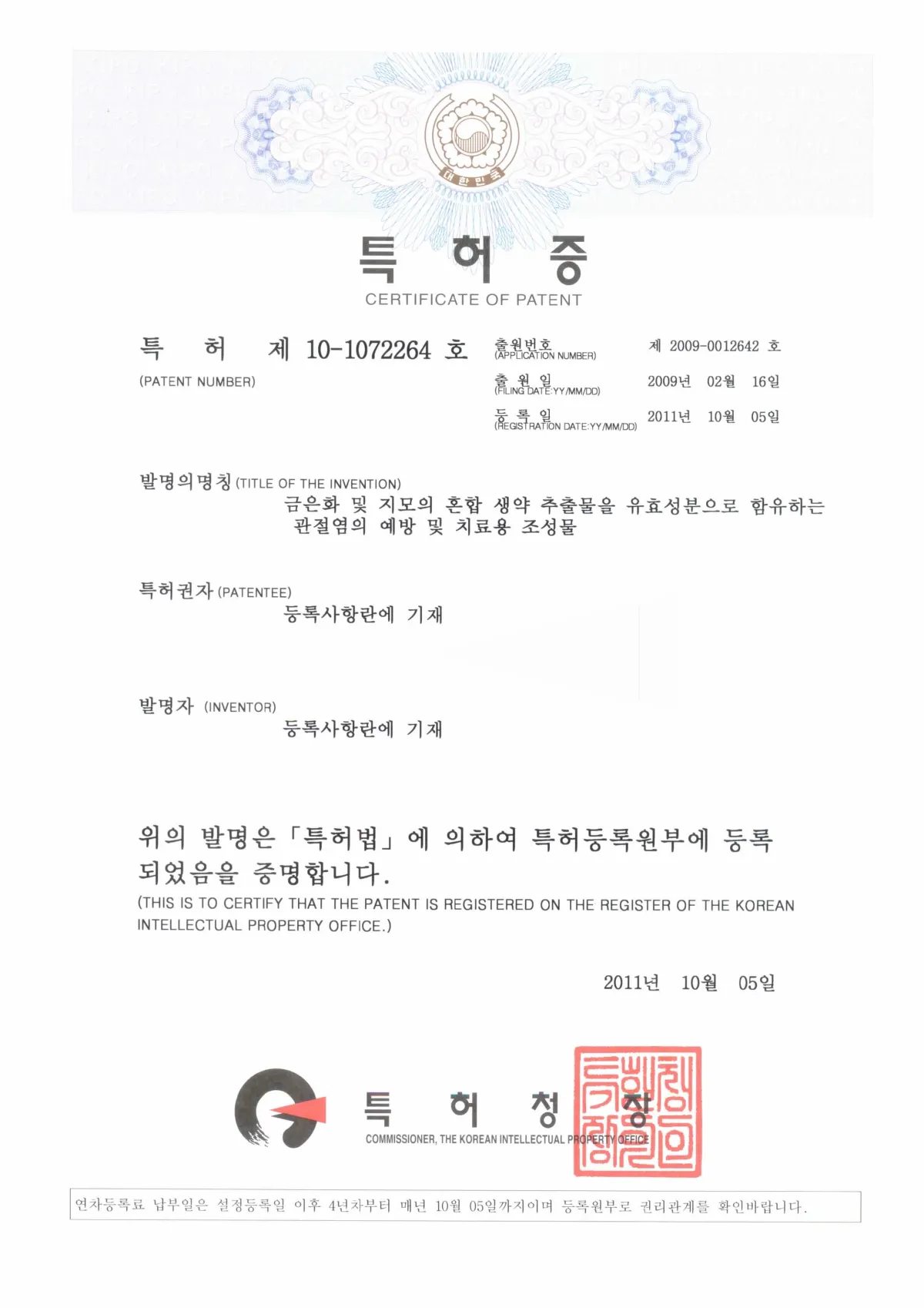
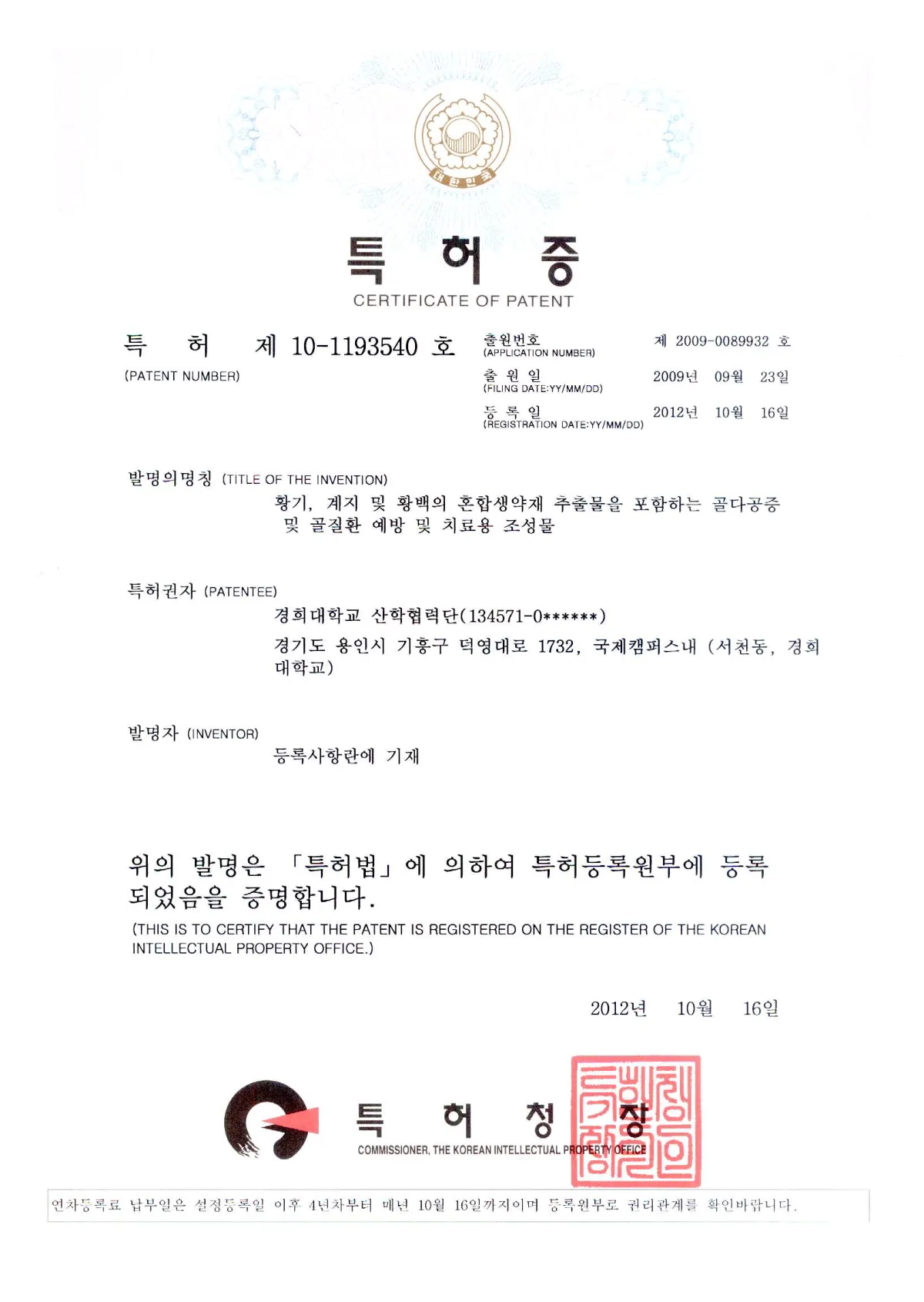
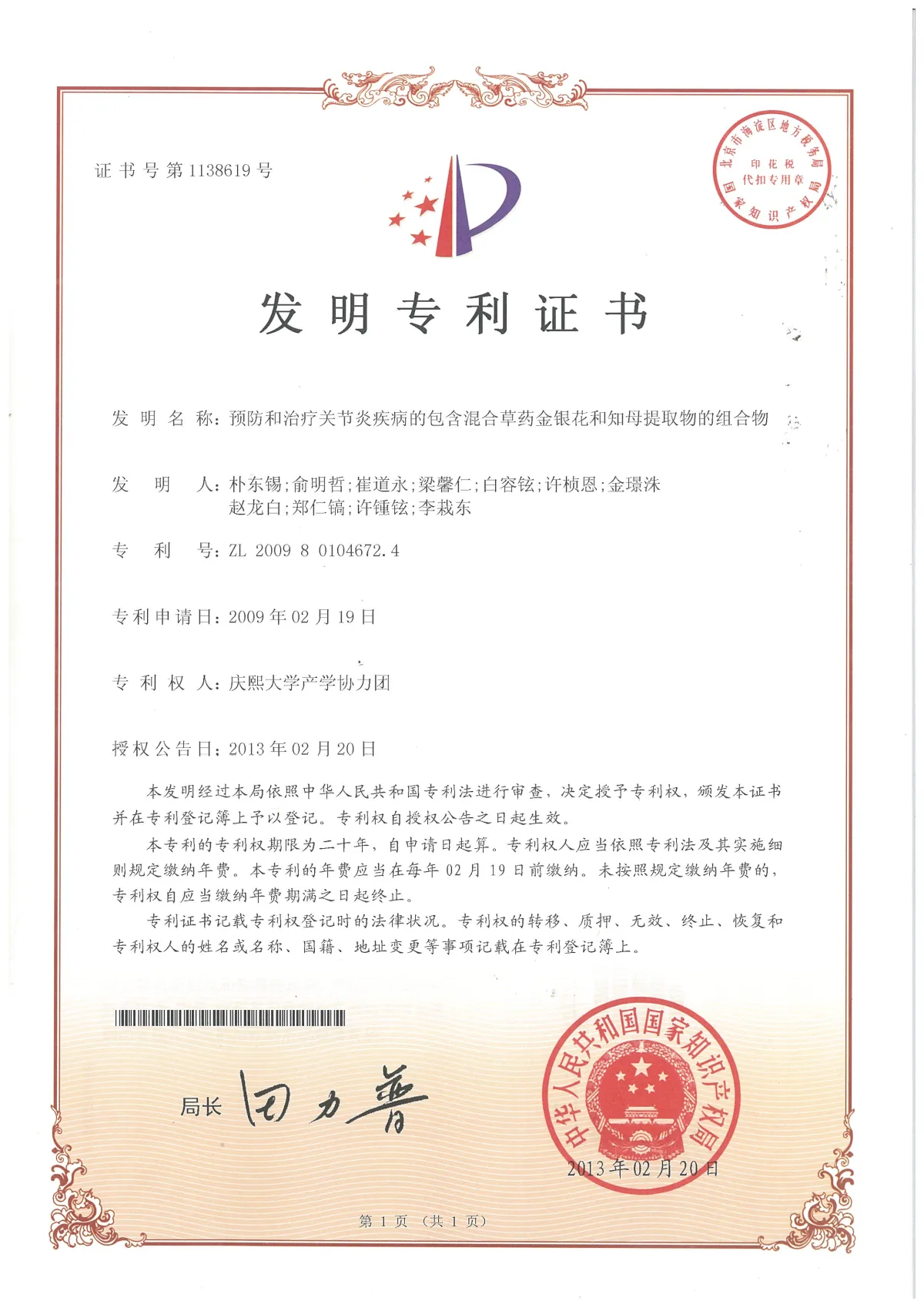
Scans of the original patent certificates. Click any document to view it at full size.
It varies by animal, but many owners report a change in movement from around four to eight weeks of consistent feeding. Joint health builds up over time, so we recommend feeding continuously for at least three months.
From six months of age. It is especially worth starting early for dogs that hesitate on stairs, very active dogs, and dogs entering their senior years.
One piece a day under 5 kg, two pieces for 5 to 15 kg, and three pieces over 15 kg. Feeding a little more is not harmful, but the recommended amount is best.
Dogs with patellar luxation were fed for four weeks with pain-index assessment, X-ray, haematological analysis and muscle-mass measurement. Pain index fell by 52% and muscle mass rose by 10%.
Eight papers on the raw-material complexes (WIN-34B · BHH10) have been published in international journals including the Journal of Ethnopharmacology. Search academic databases under the complex names.
A gastric safety study found markedly less gastric damage than conventional anti-inflammatory drugs, and non-toxicity has been reported. As a botanical material it carries little long-term feeding burden.